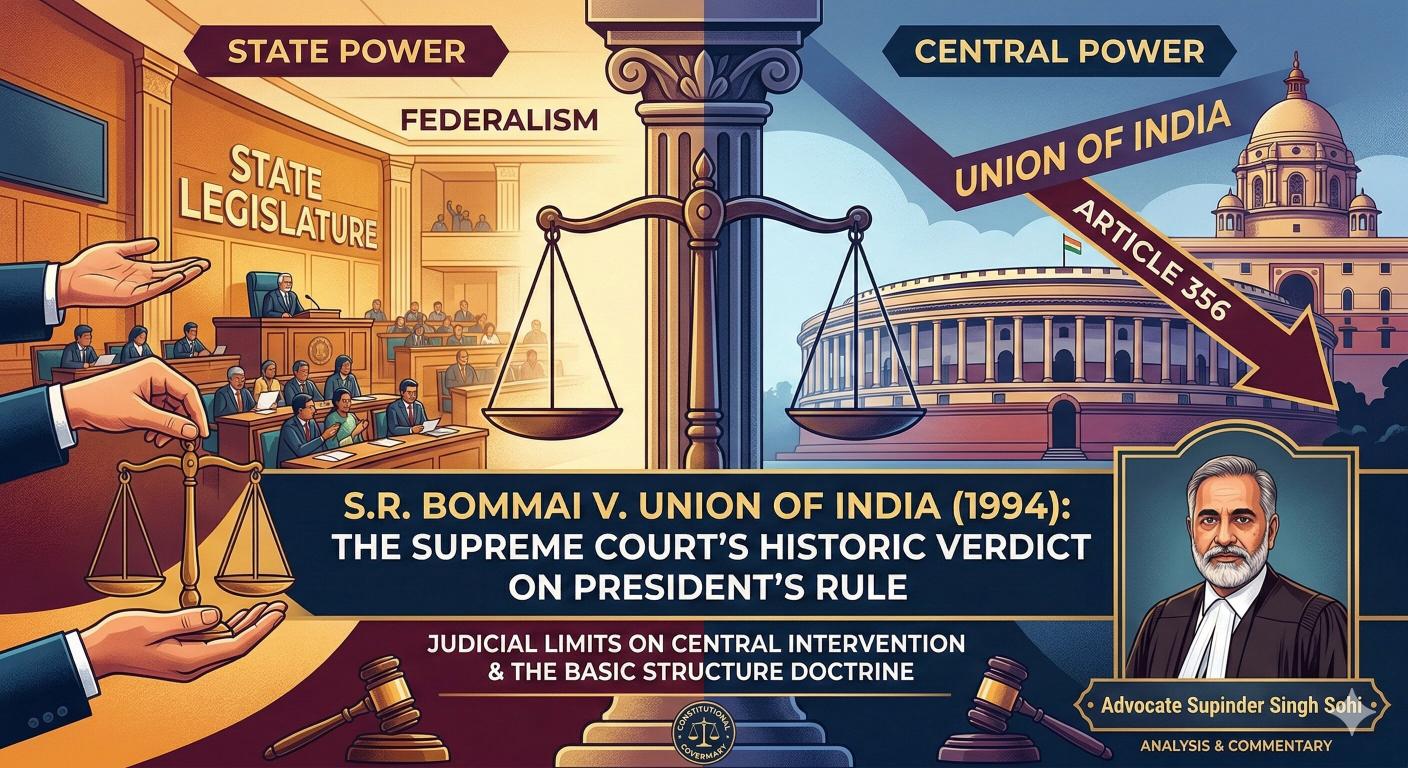
Court: Supreme Court of India
Case No.: Batch of Writ Petitions, Transfer Cases, and Civil Appeals (including Writ Petition (C) No. 16654 of 1989 and connected matters)
Citation: (1994) 3 SCC 1; AIR 1994 SC 1918; [1994] 2 SCR 644
Date of Judgment: 11 March 1994
Bench: S.R. Pandian, J.; A.M. Ahmadi, J.; Kuldip Singh, J.; J.S. Verma, J.; P.B. Sawant, J.; K. Ramaswamy, J.; S.C. Agarwal, J.; Yogeshwar Dayal, J.; B.P. Jeevan Reddy, J. (Nine-Judge Constitutional Bench)
Subject: Constitutional Law
Type: Landmark Judgment
Background and Facts
S.R. Bommai was the Chief Minister of Karnataka from August 1988, heading a Janata Dal coalition government. On 21 April 1989, the Governor of Karnataka, relying on reports of large-scale defections from the ruling coalition and a letter from some members of the assembly, recommended the imposition of President's Rule under Article 356. Bommai sought an opportunity to prove his majority on the floor of the Karnataka Legislative Assembly but was denied. The Karnataka Legislative Assembly was suspended and eventually dissolved after the proclamation was approved by Parliament. Bommai filed a writ petition before the Karnataka High Court challenging the validity of the proclamation, which was dismissed. He appealed to the Supreme Court, and the appeal was consolidated with similar challenges from other states — Meghalaya, Nagaland, Himachal Pradesh, Madhya Pradesh, and Rajasthan — where state governments had been dismissed under Article 356 on grounds that were challenged as arbitrary or politically motivated.
Issues Before the Court
The nine-judge Bench was constituted to authoritatively resolve the following questions: (1) Whether the President's satisfaction under Article 356(1) is justiciable and subject to judicial review; (2) What is the scope and extent of judicial review of a proclamation issued under Article 356; (3) Whether the state legislature should be dissolved immediately upon proclamation or only after parliamentary approval; (4) Whether the majority of the government must be determined on the floor of the House rather than on the basis of the Governor's subjective assessment; and (5) Whether secularism and federalism are basic features of the Constitution of India.
Arguments of the Parties
The petitioners argued that the imposition of President's Rule was mala fide and arbitrary, that Bommai had not been given an opportunity to prove his majority on the floor of the Legislature, that the Governor's report was based on dubious and unreliable material, and that the courts have jurisdiction to examine whether the proclamation was based on relevant material. The Union of India, on the other hand, contended that the President's satisfaction is subjective and is non-justiciable, that the Governor's report is conclusive, and that Article 74(2) bars the courts from inquiring into the advice tendered to the President.
Held and Ratio Decidendi
The nine-judge Bench, through a series of concurring and separate opinions, laid down definitive constitutional principles. On justiciability, the Court held by a majority that the President's satisfaction under Article 356 is not absolute and is subject to limited but real judicial review — the courts can examine whether the material placed before the President was relevant to the situation, whether it was sufficient to warrant a proclamation, and whether the proclamation was made in bad faith or for extraneous political purposes. While the court would not substitute its satisfaction for that of the President, it can strike down a proclamation that is based on irrelevant, non-existent, or mala fide material. On the floor test, the Court held unanimously that the question of whether a state government commands a majority must be determined on the floor of the legislative assembly and not on the basis of the Governor's subjective assessment. A Governor cannot recommend President's Rule without first affording the Chief Minister an opportunity to demonstrate majority support in the House. On the dissolution of the legislature, the Court held that the legislative assembly should not be dissolved merely on the issuance of the proclamation; it should be kept under suspended animation until the proclamation receives parliamentary approval under Article 356(3), and if Parliament disapproves, the assembly must be restored. On secularism, the majority held that secularism is a basic feature of the Constitution and that a state government which pursues an openly anti-secular agenda may lose its legitimacy. The Court also affirmed that federalism is a basic structure of the Constitution, and that Article 356, being a provision that directly impacts Centre-State relations, must be used sparingly and only as a last resort.
Key Principles / Headnotes
- The President's satisfaction under Article 356(1) is subject to limited judicial review; courts may examine whether the material relied upon is relevant, sufficient, and not malafide.
- The majority of a state government must be tested on the floor of the Legislative Assembly; the Governor cannot recommend dismissal based on his subjective assessment without affording the Chief Minister an opportunity to prove majority.
- Upon issuance of a proclamation under Article 356, the state legislative assembly should be kept under suspended animation and not dissolved until Parliament approves the proclamation; if disapproved, the assembly must be revived.
- If Parliament does not approve the proclamation within two months, the proclamation lapses and the state government and legislature stand restored.
- Secularism is a basic feature of the Constitution of India, and a state government acting in open defiance of secular values may be subject to Article 356.
- Federalism is a basic structure of the Constitution, and Article 356 must be used as a last resort and not as a political weapon by the Union government.
- Any proclamation issued in bad faith, on irrelevant grounds, or to achieve partisan political objectives is liable to be struck down by courts.
Significance and Impact
S.R. Bommai v. Union of India is without question one of the most consequential constitutional decisions in Indian legal history. Before this judgment, Article 356 had been invoked more than ninety times, often for blatant political purposes, to dislodge state governments. This judgment fundamentally transformed the constitutional landscape by establishing that President's Rule is not a tool of political convenience but a constitutional safeguard of last resort, subject to the scrutiny of courts. The requirement of a floor test before any recommendation of President's Rule has since been insisted upon by the courts in numerous cases. The judgment's reaffirmation of federalism and secularism as basic features of the Constitution has also influenced subsequent constitutional jurisprudence significantly. It remains an indispensable authority in all cases involving Article 356, Centre-State relations, constitutional morality, and the basic structure doctrine.
Read the full judgment: S.R. Bommai v. Union of India on Indian Kanoon
Summary prepared by Advocate Supinder Singh Sohi, Punjab & Haryana High Court, Chandigarh.