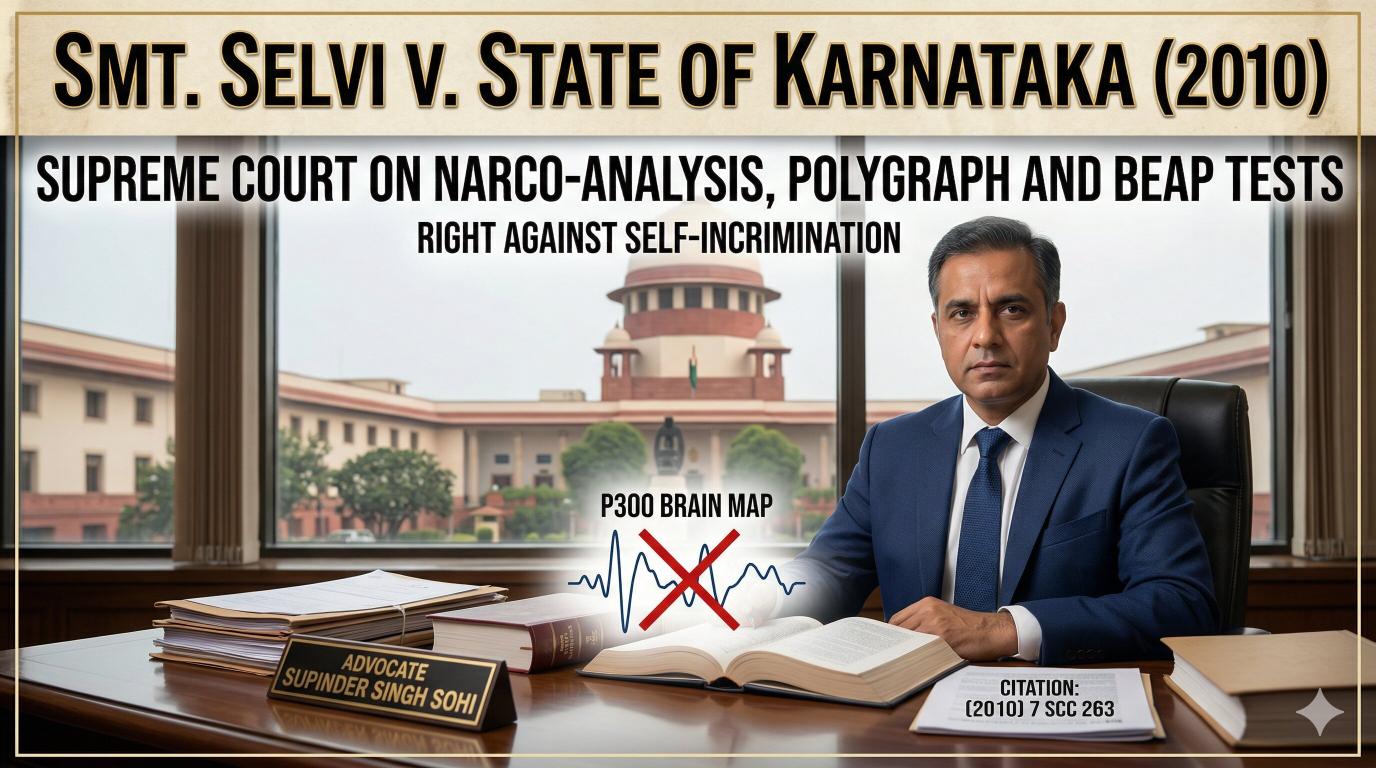
Court: Supreme Court of India
Case No.: Criminal Appeal No. 1267 of 2004 (with connected Criminal Appeals)
Citation: (2010) 7 SCC 263; AIR 2010 SC 1974; [2010] 5 S.C.R. 381
Date of Judgment: 5 May 2010
Bench: K.G. Balakrishnan, C.J.I.; R.V. Raveendran, J.; J.M. Panchal, J.
Subject: Criminal Law
Type: Landmark Judgment
Background and Facts
The case arose from a batch of criminal appeals originating from Karnataka and Gujarat, where accused persons were subjected to narco-analysis, polygraph (lie detector), and Brain Electrical Activation Profile (BEAP) tests during criminal investigations without their consent. The petitioners challenged the constitutional validity of these procedures, contending that such involuntary administration constituted a serious violation of their fundamental rights. Several lower courts had taken conflicting positions on whether such test results were admissible and whether the tests could be compelled, necessitating an authoritative ruling from the Supreme Court. The matters were consolidated and heard by a Bench of three judges including the Chief Justice of India.
Issues Before the Court
The Court was called upon to decide: (1) Whether the involuntary administration of narco-analysis, polygraph tests, and BEAP tests upon an accused or suspect violates Article 20(3) of the Constitution, which guarantees the right against self-incrimination; (2) Whether such administration also violates Article 21 of the Constitution, which protects the right to life and personal liberty; (3) Whether the results of such tests, even if the accused consents, are admissible as evidence in criminal proceedings; and (4) Whether any information or material discovered as a consequence of such tests is admissible under Section 27 of the Indian Evidence Act, 1872.
Arguments of the Parties
The petitioners argued that subjecting an accused to these techniques without consent is a form of testimonial compulsion prohibited by Article 20(3), and that the information extracted from the accused's own mental processes amounts to compelling a person to be a witness against themselves. They further submitted that the intrusion into the mind through chemical agents and external stimuli violates the right to mental privacy under Article 21. The State governments, on the other hand, argued that these were merely scientific investigative tools that did not amount to testimony in the classical sense, that the results were not confessions, and that the compulsion referred to in Article 20(3) applied only to physical compulsion in a court of law.
Held and Ratio Decidendi
The Supreme Court, speaking through a unanimous judgment authored by C.J.I. K.G. Balakrishnan, held that the involuntary administration of narco-analysis, polygraph examinations, and BEAP tests violates both Article 20(3) and Article 21 of the Constitution of India. The Court held that the protection against self-incrimination under Article 20(3) is not limited to statements made in court but extends to any compelled extraction of information from the mind of the accused, including through chemical or neurological means. The Court reasoned that "testimonial acts" under Article 20(3) include any communication of information derived from the accused's mental state, and that extracting such information against the will of the accused — whether through physical coercion or through pharmacological or neurological interference — is constitutionally impermissible. The right to remain silent encompasses the right not to have one's mind accessed without consent. On Article 21, the Court held that the administration of these tests constitutes an unjustified intrusion into mental privacy and bodily integrity, which are core components of the right to personal liberty. However, the Court carved out a limited exception: where a person voluntarily submits to such tests, with full legal advice and before a Judicial Magistrate, such tests may be conducted, though even then the results themselves are not admissible as evidence in court. Information discovered as a consequence of a voluntary test may be admissible under Section 27 of the Evidence Act as a fact discovered, provided the chain of discovery is independently corroborated.
Key Principles / Headnotes
- The right against self-incrimination under Article 20(3) is not confined to oral testimony in court but extends to all testimonial acts, including the compelled disclosure of information from an accused's mind through chemical or neurological means.
- Involuntary narco-analysis, polygraph, and BEAP tests violate Article 20(3) and Article 21 of the Constitution and their results cannot be admitted as evidence in criminal proceedings.
- An accused's voluntary submission to such tests, if made with informed consent before a Magistrate after legal advice, is permissible — but even then the test results are not admissible as substantive evidence.
- Information or material discovered as a direct consequence of a voluntarily administered test may be admissible under Section 27 of the Indian Evidence Act, 1872, as a "fact discovered".
- The phrase "person accused of an offence" in Article 20(3) includes not only those formally charged before a court but also suspects subjected to compulsory disclosure during investigation.
- The right to remain silent, guaranteed by the Constitution, extends to the right not to have one's mental processes involuntarily accessed by the State through scientific means.
Significance and Impact
Selvi v. State of Karnataka is a foundational judgment in Indian criminal law and constitutional law, drawing clear lines between permissible investigative techniques and those that breach the dignity and autonomy of the accused. It confirmed that the State cannot circumvent the right against self-incrimination by substituting psychological or chemical compulsion for physical compulsion. The judgment has had lasting influence on forensic practice in India, resulting in guidelines requiring voluntary consent and magisterial oversight before any such tests are administered. It remains the authoritative ruling on the admissibility of scientific interrogation techniques and is regularly cited in matters concerning custodial rights and the fundamental freedoms of accused persons.
Read the full judgment: Smt. Selvi & Ors. v. State of Karnataka & Anr. on Indian Kanoon
Summary prepared by Advocate Supinder Singh Sohi, Punjab & Haryana High Court, Chandigarh.