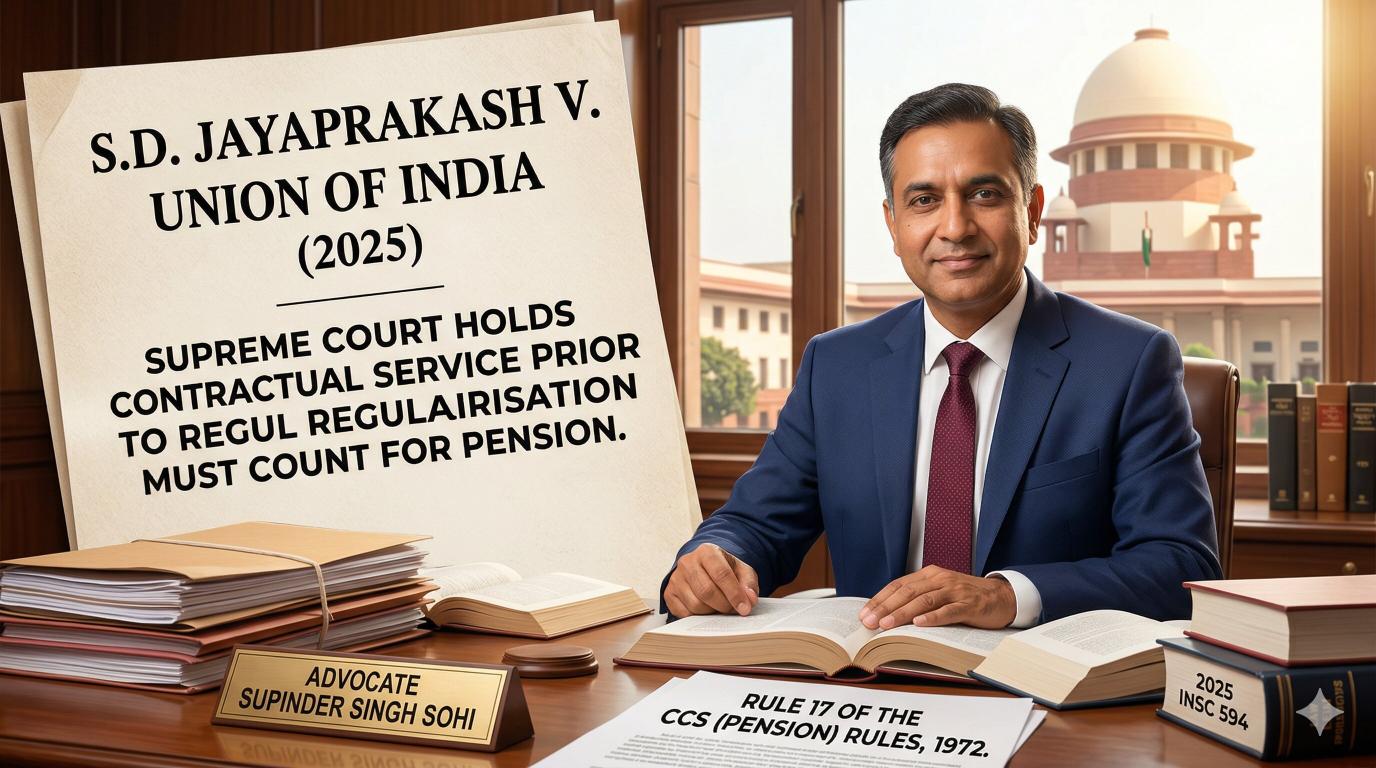
Court: Supreme Court of India
Case No.: Civil Appeals of 2025 (arising out of SLP (C) Nos. 19539–19540 of 2021)
Citation: 2025 INSC 594
Date of Judgment: 29 April 2025
Bench: Pamidighantam Sri Narasimha, J.; Joymalya Bagchi, J.
Subject: Service Law
Type: Recent Judgment
Background and Facts
The appellants (S.D. Jayaprakash and others) were appointed as Data Entry Operators on a temporary and contractual basis between 1996 and 1999 under a Central Government Plan Scheme called the “Rationalisation of Data Processing Facilities.” They continued to render service in this capacity for many years. Pursuant to orders passed by the Central Administrative Tribunal (CAT), they were regularised in 2015. After regularisation, they claimed that the period of their contractual service (from the date of their initial appointment until the date of regularisation) should be counted towards their pension under the Central Civil Services (Pension) Rules, 1972. The CAT upheld this claim and issued directions for counting the pre-regularisation service. The Union of India challenged the CAT’s directions before the High Court, which set aside the CAT’s directions, holding that pension benefits accrued only from the date of regularisation. The employees appealed to the Supreme Court.
Issues Before the Court
The principal question before the Court was: Whether the period of contractual service rendered by government employees prior to their regularisation into regular service must be counted towards the computation of pensionary benefits under the Central Civil Services (Pension) Rules, 1972, specifically under Rule 17 of those Rules.
Arguments of the Parties
The appellants contended that upon regularisation, Rule 17 of the CCS (Pension) Rules, 1972 is triggered, which mandates that the entire service — both contractual and regular — be counted for pension purposes, and that the High Court erred in confining pension benefits to the post-regularisation period only. The Union of India argued that the contractual appointment was on a different footing from regular service, that the employees were not governed by the CCS (Pension) Rules during the period of contractual service, and that pension entitlements arose only from the date of regularisation.
Held and Ratio Decidendi
The Supreme Court, speaking through a bench of Justices P.S. Narasimha and Joymalya Bagchi, allowed the appeal and set aside the High Court’s judgment. The Court held that once a contractual employee is regularised into regular government service, the Central Civil Services (Pension) Rules, 1972 apply to the entirety of their service. The Court specifically relied upon Rule 17 of the CCS (Pension) Rules, which provides that past service rendered prior to regularisation in a contractual or temporary capacity counts towards pension. The Court held that the object of Rule 17 is precisely to ensure that employees who have contributed years of service to the government in a contractual capacity are not penalised upon regularisation by having their service clock reset. Excluding the pre-regularisation period from pension computation would be contrary to both the text and spirit of Rule 17 and would result in an unjust outcome for employees who served the State for many years without permanent status. The Court partly allowed the appeal and directed the Union of India to take immediate steps to indicate the mode and manner for the appellants to exercise the option provided under Rule 17 of the CCS (Pension) Rules, including notifying any amounts the appellants would be required to remit in order to opt for pension on that basis.
Key Principles / Headnotes
- Upon regularisation of a government employee, the Central Civil Services (Pension) Rules, 1972 apply retrospectively to the entirety of that employee’s service, including the period of contractual service prior to regularisation.
- Rule 17 of the CCS (Pension) Rules, 1972 specifically provides for the counting of past contractual service towards pensionary benefits once an employee is regularised into regular government service.
- Limiting pension entitlements to the post-regularisation period, when Rule 17 provides otherwise, is contrary to the letter and spirit of the Pension Rules and results in an unjust outcome.
- The Union of India is obligated to provide the regularised employees with the option to count their pre-regularisation service for pension, as per the mechanism set out in Rule 17, and must inform them of any amounts required to be remitted for exercising that option.
Significance and Impact
This judgment is of significant practical importance for a large category of Central Government employees who were initially appointed on contractual or temporary terms and were later regularised, often after many years of service. The ruling clarifies that regularisation is not merely a prospective benefit but entitles the employee to have their past service recognised for pension purposes in accordance with Rule 17. It directly overrules the tendency of High Courts and departmental authorities to treat regularisation as marking a clean slate for pension computation, and restores the intent of the CCS (Pension) Rules to provide retirement security for the entire period of genuine government service. The judgment will have a substantial bearing on pension-related disputes across central government departments and tribunals.
Read the full judgment: S.D. Jayaprakash & Ors. v. Union of India & Ors. on Indian Kanoon
Summary prepared by Advocate Supinder Singh Sohi, Punjab & Haryana High Court, Chandigarh.