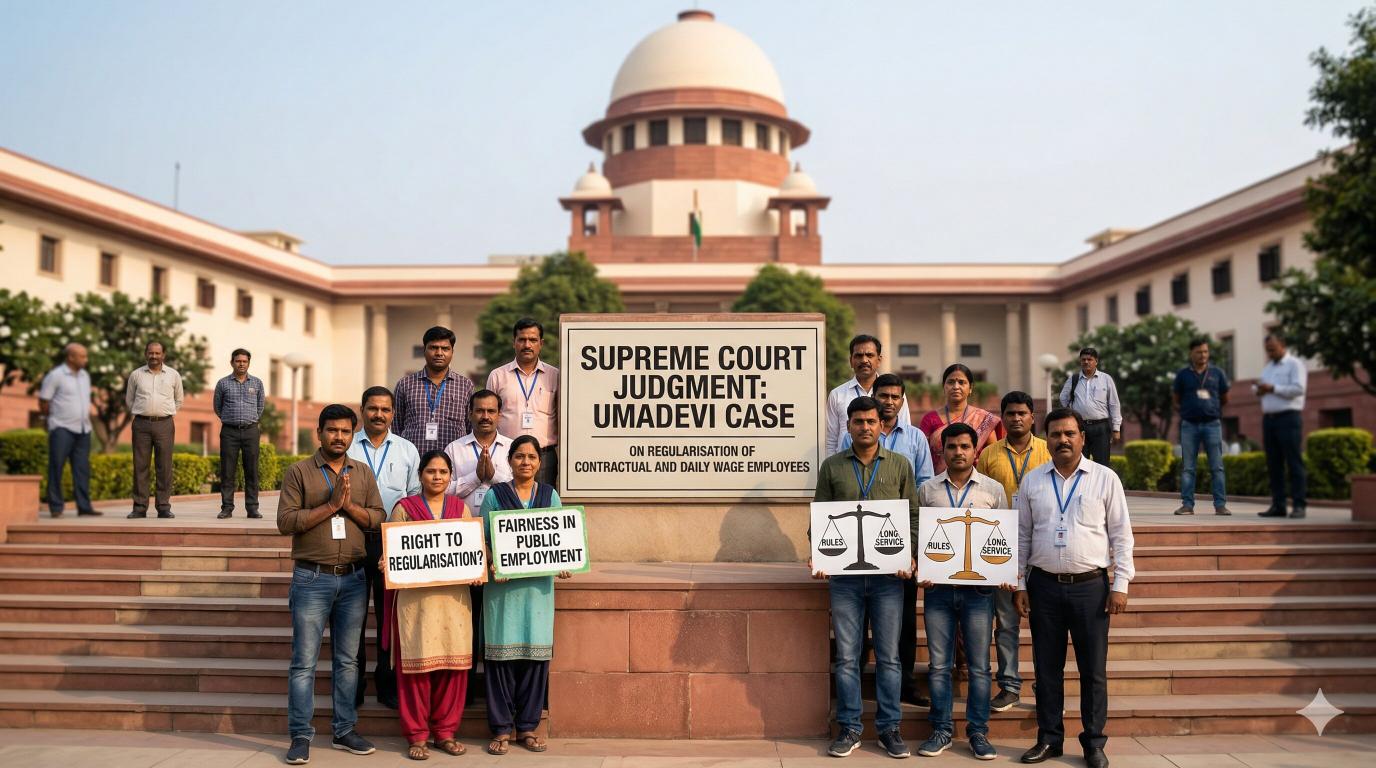
Court: Supreme Court of India
Case No.: Civil Appeal Nos. 3595–3612 of 1999 (with connected matters)
Citation: (2006) 4 SCC 1
Date of Judgment: 10 April 2006
Bench: Y.K. Sabharwal, C.J.; Arun Kumar, J.; G.P. Mathur, J.; C.K. Thakker, J.; P.K. Balasubramanyan, J. (Five-Judge Constitutional Bench)
Author of the Judgment: P.K. Balasubramanyan, J.
Subject: Service Law
Type: Landmark Judgment
Background and Facts
The respondents (Uma Devi and others) were engaged as temporary daily wage workers by the Commissioner of Commercial Taxes, Karnataka, starting from 1985–86. Over a period of more than ten years they continued to render services in the Commercial Taxes Department. The Director of Commercial Taxes recommended their absorption into permanent posts, but the State Government declined to regularise them. Various rounds of litigation followed before the Karnataka Administrative Tribunal and the High Court of Karnataka, resulting in conflicting orders — some directing regularisation, others declining it. The cases were referred to a larger bench and eventually came before the Supreme Court in the form of civil appeals challenging the High Court's directions. The matter required the authoritative resolution of a fundamental question of constitutional law: whether irregular appointments to public employment could, over time, ripen into a right to regularisation.
Issues Before the Court
The Constitutional Bench was required to determine: (1) Whether temporary, ad hoc, or daily-wage employees appointed without following the procedure prescribed by the relevant recruitment rules can claim regularisation as a matter of right on the ground of long service; (2) Whether courts or tribunals can issue directions for regularisation of such employees; (3) Whether such employees are entitled to “equal pay for equal work” as regular employees; (4) Whether the appointment of such employees without following Articles 14 and 16 of the Constitution can itself confer any enforceable rights; and (5) What directions, if any, should be issued for the one-time regularisation of employees who had served for long periods.
Arguments of the Parties
The State argued that the respondents were irregularly appointed without following the prescribed recruitment procedure, that their appointments did not comply with Articles 14 and 16 of the Constitution, and that allowing regularisation would open the floodgates for all such irregularly appointed employees across the country to claim permanent status, undermining the constitutional framework of equality in public employment. The respondents argued that having worked for more than ten years, they had a legitimate expectation of regularisation, that the principle of equal pay for equal work entitled them to the same pay as regular employees, and that their long service without regularisation itself reflected a failure of the State that could not be visited upon the workmen.
Held and Ratio Decidendi
The Constitutional Bench, speaking through Justice P.K. Balasubramanyan, issued a comprehensive ruling that settled the law on regularisation. The Court held that the right to equality in public employment under Articles 14 and 16 of the Constitution is a right of all eligible citizens to be considered for appointment through a fair and open process. An irregular appointment — one made without following the rules of recruitment — does not confer a right to regularisation, regardless of the length of service rendered. The Court reasoned that allowing regularisation of irregularly appointed employees would itself amount to discrimination against those who were never given the opportunity to apply or compete for the post. Courts and tribunals cannot, therefore, issue directions for regularisation of irregularly appointed employees as a matter of course. However, the Court acknowledged the practical reality that a large number of employees had been rendering service for very long periods and carved out a one-time exception: the Court directed that all employees who had worked for more than ten years on sanctioned posts as on 10 April 2006 without the protection of any interim orders of courts or tribunals should be considered for regularisation in a one-time measure, provided they possess the requisite qualifications. On equal pay, the Court held that temporary employees are at least entitled to the minimum of the pay scale of the post against which they work. Going forward, the Court directed that no irregular appointments should be made, and that all future appointments must comply with Articles 14 and 16 of the Constitution and the relevant recruitment rules.
Key Principles / Headnotes
- Irregular appointments to public service, made without following the procedure prescribed by Articles 14 and 16 of the Constitution and the relevant recruitment rules, do not confer any right to regularisation on the appointee, however long the service rendered.
- Courts and tribunals cannot direct the regularisation of irregularly appointed employees as a matter of right; such directions would themselves violate Articles 14 and 16 by defeating the rights of eligible candidates who were not considered.
- As a one-time measure, employees who had worked for more than ten years on sanctioned posts as on 10 April 2006 without the protection of any court or tribunal orders and who possess the requisite qualifications should be considered for regularisation by the appropriate government or authority.
- Temporary and daily wage employees are entitled to the minimum of the pay scale applicable to the post against which they are working, as a matter of the principle of equal pay for equal work.
- All future appointments to public posts must be made in strict compliance with the recruitment rules and the constitutional mandate of equal opportunity under Articles 14 and 16.
- The State cannot, by a series of irregular appointments, create a class of employees who are then claimed to have acquired a right of absorption into the regular service.
Significance and Impact
Umadevi (3) is the most cited judgment in Indian service law on the question of regularisation and is routinely applied by courts across the country. By firmly shutting the door on claims of regularisation as a matter of right, the judgment sought to restore constitutional discipline in public employment. However, it has also been subjected to extensive judicial interpretation over the years, with several High Courts and the Supreme Court itself recognising exceptions in cases of appointments made under government schemes, where employees have been working for extended periods on regularly sanctioned posts. The one-time regularisation direction has been applied in numerous states and at various levels of government. The judgment also reinforced the principle that public employment is a matter of constitutional governance and not merely contractual convenience.
Read the full judgment: Secretary, State of Karnataka v. Umadevi (3) & Ors. on Indian Kanoon
Summary prepared by Advocate Supinder Singh Sohi, Punjab & Haryana High Court, Chandigarh.